
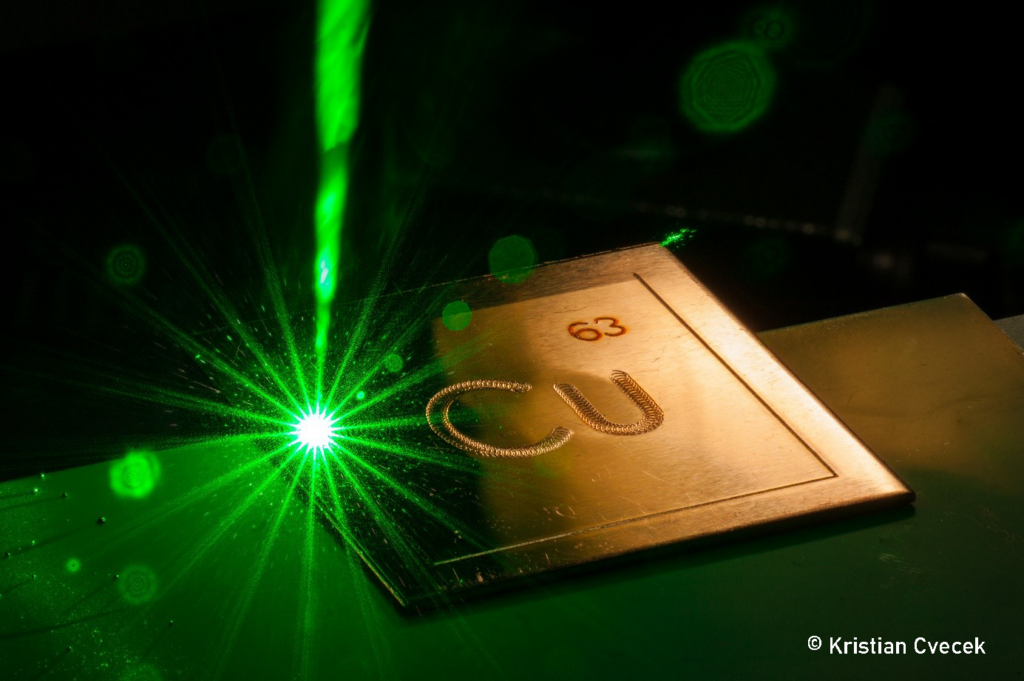
The research group focuses on laser-based joining processes such as laser beam welding or laser beam brazing. A particular focus is placed on heat conduction welding and deep penetration welding processes, as these are widely used in industry. A key aspect of our work is investigating the relationships between process control and weld seam quality, taking the underlying process physics into account.
A wide variety of laser beam sources emitting at different wavelengths are available for material processing during experimental trials. Covering infrared, green, and blue, we offer the complete portfolio of industrially relevant beam sources for laser beam welding of metals. Furthermore, we investigate the influence of static and dynamic beam shaping on the process result to suppress undesirable defects such as cracking or humping. Combined with suitable scanner optics and fixed optics, a wide range of beam diameters and peak intensities can be projected onto the workpiece, allowing us to provide the appropriate system technology for virtually any application—whether dealing with thin foils for bipolar plates or sheet metals several millimeters thick.
To build a comprehensive understanding of the process, high-performance measurement systems such as high-speed cameras, thermographic cameras, and optical coherence tomography are used. These measurement techniques enable high-resolution temporal and spatial investigation of the process zone. The underlying mechanisms of action in laser material processing can be derived from these recordings, allowing the quality of the joined connection to be significantly increased once these mechanisms are understood.
Contact person is: Dr.-Ing. Dominic Bartels